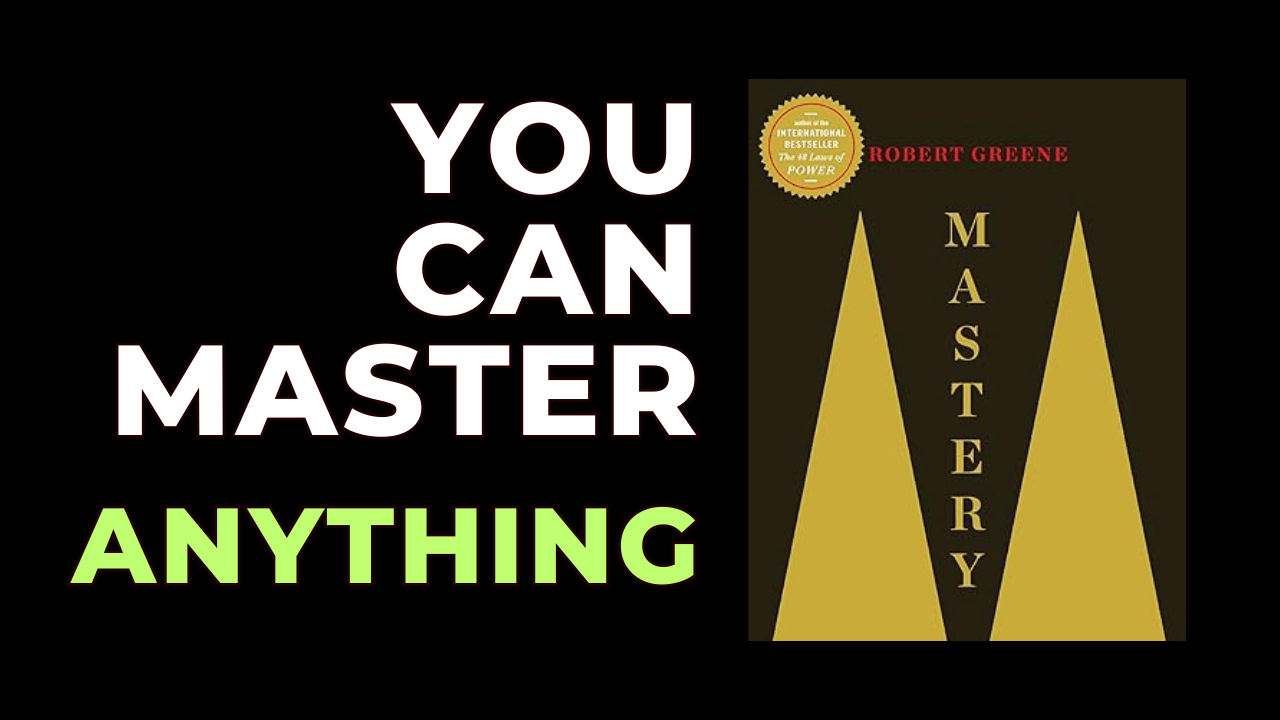
Book review. Mastery by Robert greene
Why I Keep Coming Back to Mastery by Robert Greene
(And What It Still Teaches Me About Growth, Creation & the Mind)
Watch the full video review here:
https://www.youtube.com/watch?v=InckXKCXyCk
Some books hit you once. Others grow with you.
Robert Greene’s Mastery is one of those books.
Every time I return to it — whether while training, reflecting, or rebuilding — I find something new. Not because the book changes. But because I have.
This is a book about becoming.
About how we learn, why we resist, and what it takes to become extraordinary — not through talent, but through attention, intensity, and time.
What Is Mastery Really About?
Greene shares the lives of master creators across centuries — Da Vinci, Temple Grandin, Einstein, Steve Jobs, Marie Curie, Freddie Roach, Coltrane — and distills the exact process they followed to become extraordinary. Not just talented. But masterful.
It’s less a how-to and more a philosophy of practice.
A permission slip for obsession.
A reminder that creation — not consumption — is where we become fully human.
What Mastery Teaches About the Mind
In Chapter 6, Greene explores a core idea that shaped my own journey:
Fuse the intuitive with the rational.
This is the exact path I’ve taken in performance, physiology, and teaching — learning deeply, then shaping it into something new. Something personal.
Take Temple Grandin, for example — a woman with autism and a fear center three times larger than average.
Her heightened sensitivity allowed her to see the world through the eyes of animals — especially cattle — and revolutionize how we treat them.
It’s a perfect example of what Greene calls “the transformation.” Turning what some see as weakness into unique mastery. That pattern is everywhere.
What Great Trainers Understand
In boxing, Greene writes about Freddie Roach, who trained under legendary coach Eddie Futch before becoming a master coach himself. He didn’t just copy techniques — he absorbed the mindset. Refined the process. Created something deeper from experience.
That’s my intention with my own training work — to build a better workflow, a better place, grounded in lived experience.
The best trainers don’t follow a script. They build from what they’ve learned, felt, and fought through.
The Creative Brain (and the Drug Myth)
In the final section, Greene boldly challenges a cultural myth:
That creativity comes from chaos, or substances.
Instead, he shows how the greatest thinkers and creators — Einstein included — relied on deep focus, stillness, and joy in repetition.
As someone who’s spent years exploring physiology and flow states, I can confirm this:
True creativity doesn’t come from hacks.
It comes from honouring the work.
A Pattern I Keep Seeing
Whether it’s Federer, Jobs, or jazz legend John Coltrane, the same pattern emerges:
- Learn from others deeply
- Obsess over details
- Then… break the rules
- And find your own voice
Coltrane, for instance, worked with every great player of his time — then went fully his own way. Encouraged by Miles Davis, he followed his inner sound.
He died young, but changed jazz forever.
Same with Curie. With Newton. With every human who’s ever stretched the limits of what we thought was possible.
Final Reflection: Why This Book Matters (Still)
At one point, Greene says:
“The master is not a special kind of person. But every person has the potential to become a master.”
That line always gets me. Because I believe it.
I’ve lived it. I’m still living it.
In fact, my life right now mirrors one of Einstein’s own strategies:
Choosing work that gives me the space to explore, learn, and create.
That’s what Mastery is really about — building the life that lets you become more of who you truly are.
Watch the Full Review Here:
The video is not released yet and will appear here when it is.
https://www.youtube.com/watch?v=InckXKCXyCk
Have you read Mastery?
Which story, insight, or principle stayed with you the most?
Drop a comment — or share this with someone walking their own path toward mastery.