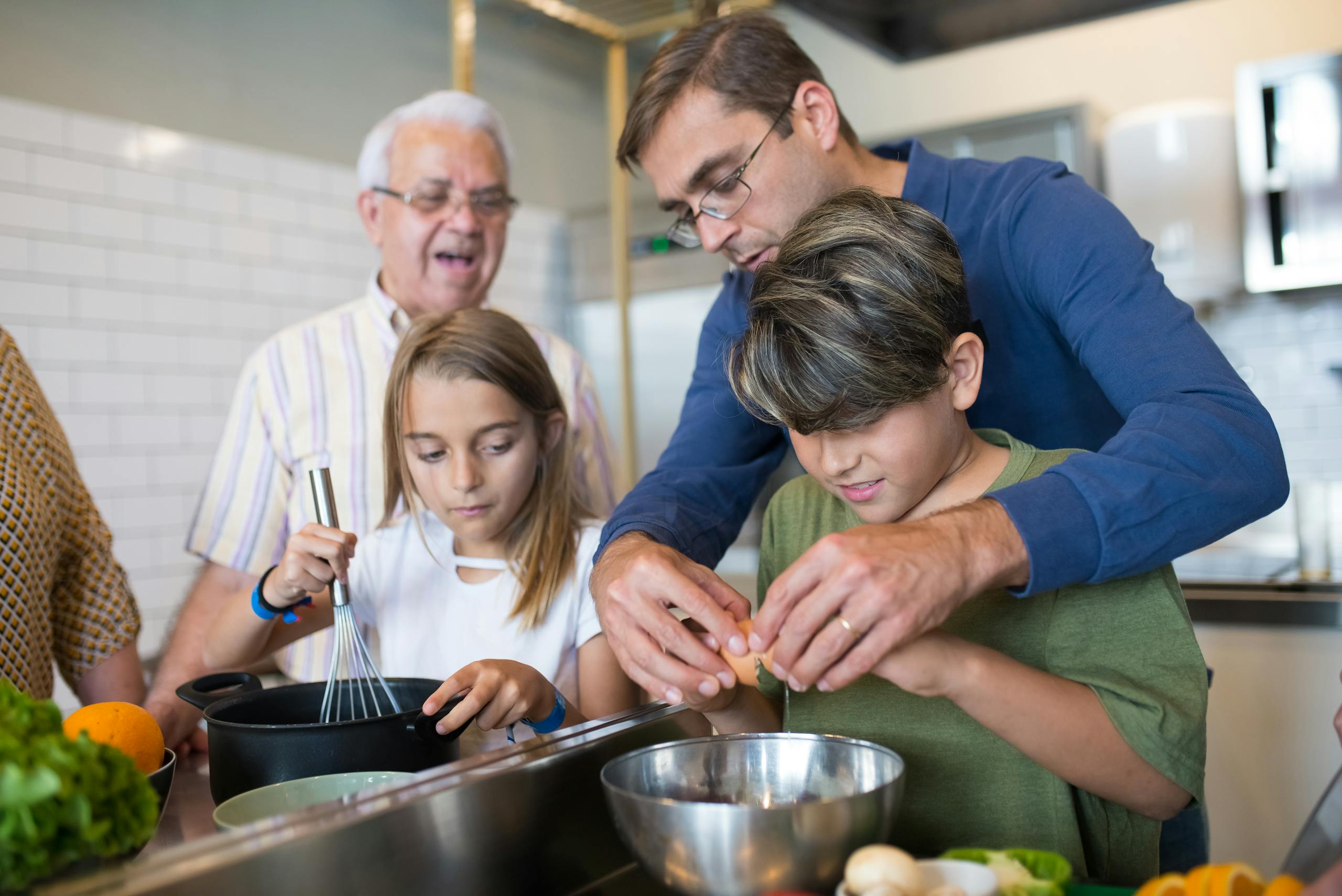
Learn to Cook
Learning to cook is an amazing healing habit. Learn how cooking teachers, recipes, shopping, and simple meals can help you begin using food as a whole-life healing habit
Cooking is a great healing habit because it supports nourishment, movement, shopping, confidence, family rhythm, daily activity, and the way life supports you through food.
Cooking is one of the best places to begin with Healing Habits.
Not because you need to become a chef.
Not because every meal has to be perfect.
But because cooking sits right in the middle of daily life.
You shop.
You carry food home.
You unpack it.
You prepare it.
You move around the kitchen.
You feed yourself.
You feed others.
You clean up.
You learn what works.
You repeat.
That means cooking is not just about nutrition.
It is an activity, a lesson, and a healing habit all at once.
Why cooking matters
Cooking is one of the oldest human activities, and the existing Fit2Thrive cooking page already connects it to human development, energy, nutrition, and breaking through biological limits.
That is why cooking matters inside Healing Habits.
Cooking can help with:
food
energy
nutrition
shopping
daily rhythm
family life
movement
confidence
creativity
recovery
social connection
planning
self-trust
When you learn to cook, you are not only learning recipes.
You are learning how to support yourself.
That is a very practical form of investing in you.
Cooking is a whole-life healing habit
It is easy to think cooking only belongs under food or nutrition.
But cooking reaches much further than that.
Cooking includes Supply because it helps you provide food, energy, nutrients, comfort, and rhythm.
Cooking includes Demand because shopping, carrying, chopping, stirring, standing, cleaning, and moving around the kitchen all ask something of your body.
Cooking includes Recovery and Regulation because a simple food rhythm can make life feel calmer, more prepared, and less chaotic.
Cooking includes social connection because meals often connect families, friends, cultures, traditions, memories, celebrations, and care.
Cooking includes learning because every recipe teaches you something.
So cooking is not one isolated habit.
It is a doorway into many healing habits.
That is why the right cooking teacher can be so powerful.
They do not only teach you how to make a meal.
They help you begin building a life where food supports you more often.
Why beginners need cooking teachers
A lot of people find cooking hard.
Not because they are lazy.
Not because they are broken.
Because they were never really taught.
They may not know what to buy.
They may not know what to cook.
They may not know which recipe will work.
They may not trust themselves in the kitchen.
They may feel judged by food culture, health advice, diets, chefs, social media, or family expectations.
That is where teachers matter.
A good cooking teacher helps you begin without shame.
They make cooking feel possible.
They help you take one step.
That is the Level 1 standard.
For Healing Habits, the best cooking teacher is not always the most impressive chef.
It is the teacher who helps you cook.
Teachers help you ACT
Fit2Thrive is built around ACT:
Activities — what you do
Curriculum — what you understand
Teachers — who or what helps you apply it
Cooking is the activity.
Understanding food, supply, nourishment, energy, shopping, rhythm, and habit is the curriculum.
Cooking teachers help you turn that understanding into action.
They help you ACT.
That is the point of this page.
It is not here to tell you there is one perfect way to cook.
It is here to help you find a teacher who makes cooking easier for you to begin.
Start with a teacher who meets you where you are
There are thousands of cooking teachers.
Some are chefs.
Some are parents.
Some are friends.
Some are YouTube creators.
Some are recipe writers.
Some are books on your shelf.
Some are people you grew up with.
Some are restaurants, cultures, traditions, or memories.
The teacher does not have to be famous.
They just have to help you begin.
Ask:
Do they make cooking feel possible?
Do they explain things in a way I understand?
Do they help me feel less judged?
Do they make food feel enjoyable?
Can I try one thing from them this week?
That is enough.
Jamie Oliver: cooking without judgment
Jamie Oliver is one useful Level 1 cooking teacher because he helps beginners and non-cooks feel that cooking can be simple, relaxed, fun, and possible.
That is why he fits this page.
He is not here as a celebrity chef profile.
He is here because he helps people start.
The existing Jamie Oliver page says his relaxed style makes cooking accessible to normal people, that he has worked to get more people cooking quality food at home, and that he has a knack for getting people to want to cook. It also says that if someone is struggling to learn to cook, Jamie’s recipes are easy, tasty, and likely to include something that fits their time, budget, and tastebuds.
That is exactly what a beginner teacher should do.
They meet you where you are.
They make the next step feel possible.
They help you stop thinking, “I can’t cook,” and start thinking, “I could try that.”
Michel Roux: simple food wisdom
Michel Roux is another useful cooking reference already in the Fit2Thrive library.
The link-library includes the article:
Michel Roux: you don’t need a protein with every meal
That is a simple example of why cooking teachers matter.
Sometimes a teacher gives you a full recipe.
Sometimes they give you one idea that changes how you think.
“You don’t need a protein with every meal” is not just a cooking tip.
It can loosen the pressure around food.
It can make meals feel easier.
It can help someone think more flexibly.
It can make cooking less expensive, less rigid, and less intimidating.
That is a healing habit moment.
Not because the idea solves everything.
But because it helps someone begin thinking differently.
Other cooks can help too
Jamie Oliver and Michel Roux are only examples.
You might learn from Nigella Lawson, Nigel Slater, a parent, a grandparent, a friend, a cookbook, a food blog, a YouTube channel, a recipe card, or a local cooking class.
The point is not to find the one official Fit2Thrive cooking teacher.
The point is to find someone who helps you cook.
Some teachers make food feel joyful.
Some make it simple.
Some make it cheap.
Some make it healthier.
Some make it family-friendly.
Some make it comforting.
Some make it creative.
Some make it less scary.
That is why you can mix and match.
You may use Jamie Oliver to get started.
Michel Roux to think differently.
A family recipe to feel connected.
A simple soup recipe to practise.
A shopping page to gather better ingredients.
A leftovers idea to waste less and make life easier.
This is how cooking becomes yours.
Cooking begins before the kitchen
Cooking does not start when the pan goes on.
It often starts when you shop.
Shopping is one modern form of hunting and gathering.
You gather the food, ingredients, tools, ideas, and possibilities that shape what becomes easy later.
If your kitchen contains nothing you know how to use, cooking becomes harder.
If your kitchen contains a few familiar ingredients and one simple recipe, cooking becomes easier.
So learning to cook can include learning to shop.
It can include asking:
What do I already know how to cook?
What do I want to learn?
What food supports my energy?
What does my family actually eat?
What one ingredient could make this week easier?
What one recipe could I repeat until it feels normal?
That is how cooking becomes a real-life healing habit.
Not perfect.
Practical.
Cooking also gets you moving
Cooking is not formal exercise, but it is still activity.
You stand.
Reach.
Chop.
Carry.
Stir.
Bend.
Wash.
Serve.
Clear.
Move between cupboards, fridge, sink, hob, table, and bin.
For many people, that matters.
Healing Habits is not only about adding workouts.
It is also about noticing the movement already built into daily life and making it more useful.
Cooking can turn a passive food habit into an active one.
Instead of only ordering, opening, or grazing, you start preparing, choosing, adjusting, tasting, and learning.
That is a different relationship with food.
And it is a different relationship with your body.
A small way to begin
Start with one teacher and one recipe.
That is enough.
You could try:
one Jamie Oliver recipe
one Michel Roux idea
one family recipe
one soup
one tray of roast vegetables
one simple lunch
one pasta dish
one breakfast you can repeat
one leftovers experiment
one recipe that uses food you already have
Do not make it big.
Make it repeatable.
The habit is not “become a great cook.”
The habit is:
I am learning how to feed myself better.
That is a beautiful place to begin.
A gentler next step
You do not need to become a brilliant cook to start using cooking as a healing habit.
You only need one small step, one useful teacher, and one meal you are willing to try.
If this idea speaks to you, HEAL gives you a gentler introduction to the Fit2Thrive approach.
And when you are ready to begin practising small daily healing habits, Healing Habits shows you how to start with 5–10 minute investments that help life support you more than it drains you.
Explore cooking more deeply
You do not need these pages to get started.
But if you want to go further, these pages can help you explore cooking, shopping, nourishment, teachers, recipes, and food as part of Healing Habits.
Start with the Fit2Thrive route
Cooking teachers
- Jamie Oliver: The Naked Chef
- Getting Jamie Oliver to help you in the kitchen?
- Michel Roux: you don’t need a protein with every meal
Simple cooking ideas
- How to spend more time with family while Learning to cook
- Make effortless roast vegetables in advance
- Effortless and nutritious Parsnip and Carrot soup
- Stilton and onion pastryless quiche
- Simple lunches: Avocado, cherry tomatoes and pasta
Flexible food habits
- Can takeaways be healthy?
- Can you make stock for free from takeaway leftovers?
- Is Gently Cooked Food Better for You?